

- Remote Work
- Time Management
- Gamification
- Leave & Attendance Management
- Cryptocurrencies
- Web Development & SEO
Application of Project Management Methodologies & Problem-Solving Methods. A Sample Project
Last updated

The previous article discussed the existing project and process management methodologies, problem-solving methods, and idea generation techniques. Still, it may be easy to get lost when applying all the methods and techniques to real-life projects. Let’s review an example project.
Imagine you will work on a startup — a software development project. You should analyze the idea, gather requirements, set initial goals, understand all phases of the project, form a team, clarify each member’s role, understand all project and organization restrictions, and analyze risks. Then you can start working on the first simple version, usually referred to as Minimal Viable Product (MVP). It should be delivered as soon as possible to get initial feedback from customers and some other metrics to see if you have chosen the right direction. If all goes well, you can continue with more features, launch, and continue working on new sophisticated versions.
Let’s see how you can cope with this. Note that the methods suggested below are only examples to illustrate a possible workflow. Depending on a project and your team’s preferences, you can apply a different set of tools.
Discovering Innovative Solutions. Design Thinking
When initiating a software startup project, you should have your goals defined already (they may change later, and that’s fine). The main challenge is how to achieve those goals in the best possible way. In other words, you have to find quality and innovative solutions for many problems you discover on your way. And the quality of these solutions will determine whether your project succeeds or fails in the future. Precisely on this stage, you should use your creative thinking. It is where the Design Thinking process comes into play. It’s focused on qualitative insights.
Design Thinking is a creative human-centered process that consists of 5 stages: Empathize, Define, Ideate, Prototype, Test.

Empathizing is the understanding of user needs through user research. Here you should set aside your assumptions and obtain real insights into user behavior and their demands. You can ask questions and watch how users are working to understand the challenges they face and how they cope with them.
The Define stage is when you should accumulate the information gathered during the first stage and determine problem statements.
The Ideate stage is when the project team generates ideas. Think outside the box using the information from the previous two phases. Use idea-generating techniques (Round-robin brainstorming, Six Thinking Hats, The Five Why’s, Failure Mode and Effects Analysis, Walk Away, or the Wanderer Technique and others) to find alternative ways to view a problem and uncover innovative solutions.
Prototyping is producing a scaled-down simple version of a product to validate the ideas developed earlier. For software, it can merely be a set of images illustrating how the future app will look and work. Some services ( Figma ) allow designing user interfaces and creating user journey maps quite quickly.
Testing is evaluating the prototype and its ability to solve the defined problems. Involve real users to see how they react to your prototype and gather their feedback. Try to conjecture how they will use the product in real life and whether it would be the most efficient way. If there are issues encountered in the proposed prototype during testing, the team should go back to one of the previous stages to develop better ideas and improve the prototype.
Note that these stages are not a strict sequence of steps to loop through. Whenever needed, you can return to a previous stage to make iterations, alterations, and refinements to discover new or enhance existing solutions.
Development of a Minimum Viable Product (MVP). Lean Startup
Once you have a validated prototype, it’s time to start working on your application. At this point, most likely, you will not have a validated business model. To verify the model, including the solutions gained earlier, it is crucial to create a first version of the product quickly, show it to users, and analyze all produced data. Here you can rely on the Lean Startup methodology.
Lean development means removing everything unnecessary (waste) and focusing on the essentials to deliver the first version of a product as soon as possible. The core component of the Lean Startup approach is the Build-Measure-Learn loop.

At the Build step, the team prepares a new version of a product, focusing on vital features. Then the team can start the Measure-Learn process — collect and analyze specific metrics, including user feedback. At first, Lean can employ qualitative insights, but later on, actionable quantitative metrics should be used to measure how effective the solution is. The received results help to decide whether it’s time to pivot or the project can persevere.
Design Sprint
Within the Lear Startup approach, you can use the Design Sprint technique to find suitable solutions promptly. The main strength is that the entire sprint lasts only five days. Every day of a week is devoted to a particular activity: Monday — map out the problem, Tuesday — sketch out possible solutions, Wednesday — decide how to proceed, Thursday — prototype, Friday — test the prototype and get feedback from real-life users.

Given the short timeframe, Design Sprint usually allows focusing only on something simple; however, it’s a great way to validate every step you take and make sure you are always on the right track.
Agile
Once your product’s business model has been validated you can shift to a more traditional way to develop software — the Agile approach. There are many Agile project management methodologies to choose from. They all are user-focused, iterative, and utilize the same Design-Develop-Test-Deploy-Review loop.
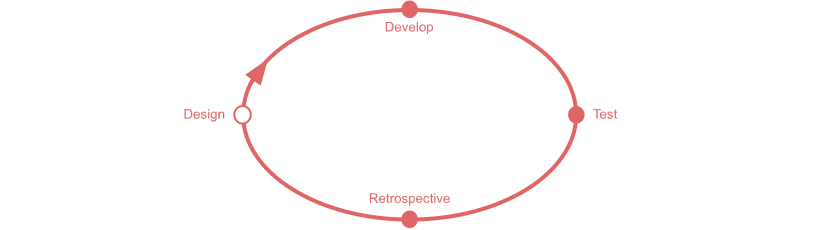
Summary
Now let’s grasp the entire lifecycle of the project and put all of the reviewed phases on a timeline.
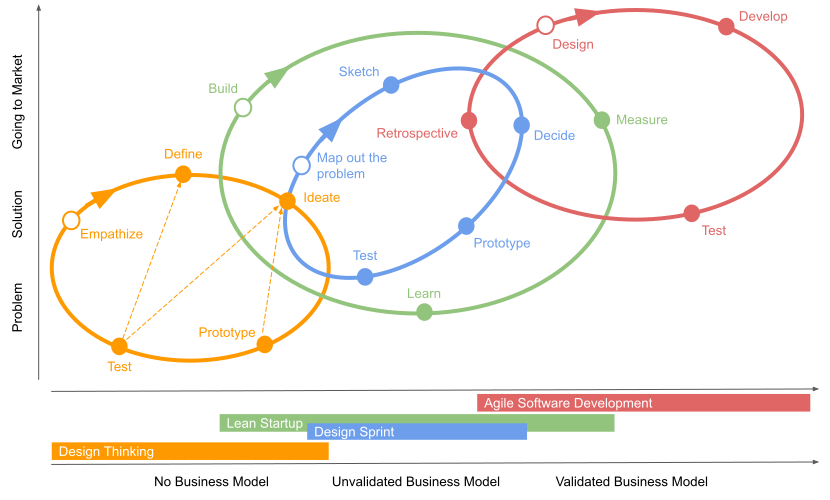
First, you unearth your solutions using design thinking, then start working on a minimum viable product to prove that your business model is correct, and then launch and continue to develop and maintain the product.
The mentioned methodologies and techniques often overlap, and in fact, follow similar principles. Every team would have to fine-tune its processes and master many techniques to be creative and productive during any project stage. No rule would allow building a generic process suitable for any startup.
ReferencesEnterprise Architects Combine Design Thinking, Lean Startup and Agile to Drive Digital Innovation