

- Remote Work
- Time Management
- Gamification
- Leave & Attendance Management
- Cryptocurrencies
- Web Development & SEO
The Hidden Engine of Productivity: Why Wellbeing Is Your Best Strategic Asset
Last updated

In the high-pressure world of modern business, the word “wellbeing” is often dismissed as a secondary concern—something to address with a yoga app or a bowl of fruit in the breakroom. However, as we navigate 2026, the data tells a different story: wellbeing is the engine of performance, not just the fuel.
To avoid the catastrophic costs of burnout and high turnover, leaders must prioritize psychological safety. This concept, popularized by Dr. Amy Edmondson in her seminal 1999 research, describes an environment where employees feel safe to take risks and admit mistakes without fear of punishment. When this safety is absent, innovation dies, and stress begins to simmer beneath the surface.
The Silent Struggle: When High-Performers “Hide”
One of the most dangerous myths in management is that underperformance is always a sign of a "bad" hire. In reality, many employees are experts at masking. They carry heavy burdens—personal crises, family illnesses, or financial stress—while trying to maintain a professional exterior.
This leads to a phenomenon known as presenteeism: being physically (or digitally) present but mentally absent. Paul Hemp’s classic analysis for the Harvard Business Review highlights that presenteeism can cut individual productivity by one-third or more. Often, these aren't “lazy” workers; they are talented professionals struggling with unmanageable workloads or toxic team dynamics who feel they have nowhere to turn.
The Management Trap: Pushing Instead of Probing
When a manager notices a dip in performance, the instinctive reaction is often to “tighten the screws”—more check-ins, stricter deadlines, or corrective feedback. However, pushing an already burnt-out employee is like flooring the accelerator on a car with no oil; you’ll only cause a total engine failure.
To fix this, many companies rely on annual or monthly engagement surveys. While well-intentioned, these are often “too little, too late.” A survey sent in December cannot help an employee who hit their breaking point in October.
Why Daily Wellbeing Tracking is the Future
To truly support a team, you need a pulse, not a snapshot. This is why forward-thinking organizations are moving toward daily wellbeing tracking.
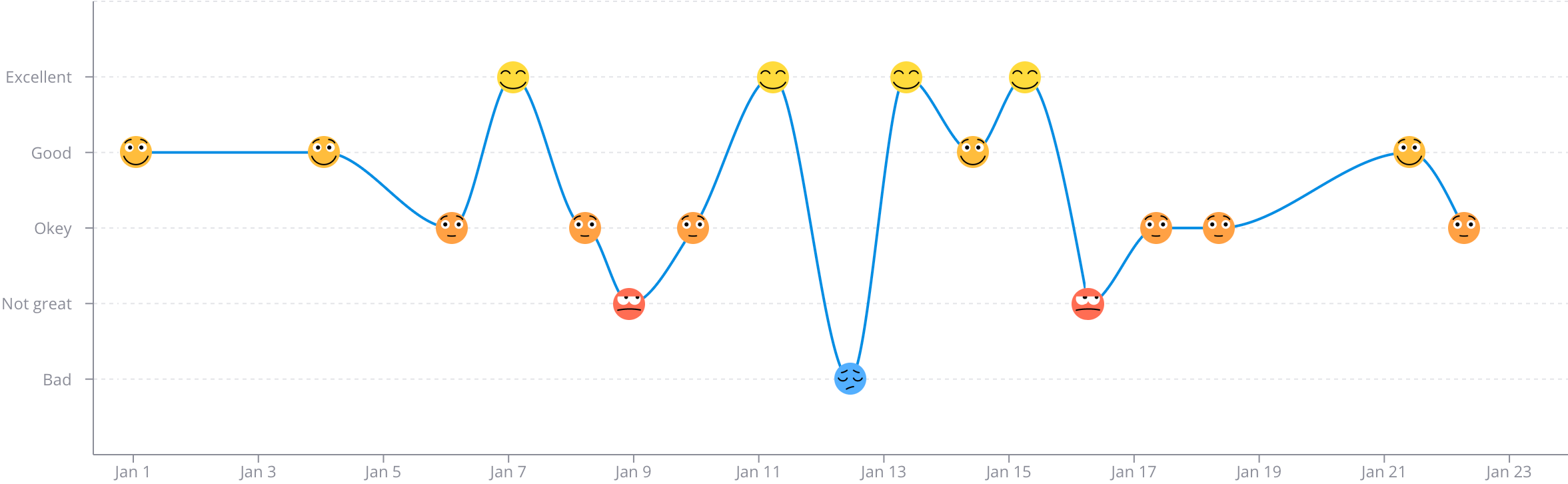
Systems like Trackabi.com are revolutionizing this space by offering integrated mood tracking. Instead of waiting for a crisis, employees can quickly share their daily state—indicating their mood, what impacted it, and any specific thoughts—in just a few seconds.
The power of this data lies in its context. By mapping wellbeing scores against productivity metrics and time spent at work, managers can identify patterns:
- Is a specific project causing a spike in stress across the whole team?
- Does a remote worker’s mood dip every Tuesday during a certain client call?
- Is "overload" a chronic issue or just a temporary hurdle?
This proactive approach allows for “Micro-Interventions”—small adjustments made today that prevent a total burnout three months from now. Research by Schultz and Edington (2007/2019) confirms that addressing these health and mood "risks" early is the only way to significantly reduce the long-term hidden costs of lost productivity.
Conclusion
Wellbeing is not a distraction from “real work”—it is the foundation of it. By moving away from reactive “telling off” and toward a culture of daily, data-driven empathy, managers can build teams that are not only more productive but also more resilient. In the end, a company that tracks the happiness of its people is a company that is built to last.